Visitor Count

Sunday, 19 June 2011

Function 4 Junction: Part 1

Junction City is a conurbation a few miles north of Eugene. It was named in the hope that it would be chosen as a major site for trains in the Pacific Northwest to stop for delivering and collecting freight, but lost out to Eugene for reasons I have mentioned previously in this blog.


As a consequence it's a bit of a backwater for most people, somewhere to travel through on the road from Eugene to Corvallis or Newport.


The tracks run straight South towards Eugene...


and straight North towards Albany.


This bit was left over when they finished laying the tracks.


Once a year Junction City hosts the Function 4 Junction Car Show, when owners of "interesting" vehicles for miles round gather together to show their vehicles throughout the day, and have a drive up and down the strip in the evening. The joy for an outsider is that the owners pay to show their vehicles, while the general public (i.e. me) pays nothing - not even to park.


An area was cordoned off around a crossroads just off the main road (Highway 99), and here the show took place. I estimate there were nearly 100 vehicles on show, and more attended the evening cruise. The show is not limited to any specific decade, make, model or anything else, so there was a tremendous cross section of American Vehicular Splendor to be seen.

I'd like to have seen the vehicles organised a little more myself, so that one could walk through the decades and see the development in styles and ideas. Thus in my rough and dirty guide to Function 4 Junction I am organising my photos into groupings that make sense to me.   


1920s and 30s


This car (I don't recall the make, but it's not a Model A Ford) was actually parked a little outside the official show area, but probably the oldest I saw that day. The boxy body, flat windscreen, running boards, and substantial spring-mounted fenders (bumpers)  all mark it out as a late 1920s car.


Five pedals? Yowsers. The functional rather than styled dashboard at least has most of the instruments considered necessary for modern driving.


Another 20s car here has been heavily customised, yet is still clearly showing its pedigree.


A customised pickup rounds out the 20s for me. I found that I prefer seeing a restored car rather than a customised car, though I appreciate the skill and work required for both branches of show cars.


Behind the engine and wheel replacement this custom hotrod shows its pedigree.


This wonderful restoration from 1938 is perhaps my favorite from the show. It retains the running board, but the windscreen has now been split and angled in a nod to aerodynamics. The headlights are still housed separately and the engine accessed from the sides of the vehicle, the nose being almost entirely radiator. This style of car remained throughout WW2, as factories were busy with bombs, tanks and areoplanes, and had no time for redesigning vehicles. Winston Churchill and General Eisenhower would not have looked out of place in the back of this car.


1940s


This customised milk float shows its 1940s roots in the split flat windscreen, flared wheel arches and vestigial running board.


Still with a split flat windscreen, the headlights have now been absorbed into the main bodywork of the car, and the running board remains only as a slight flaring out of the doors and panels.


You cold be forgiven for thinking this is the same vehicle as in the previous picture, but check the radiator grille. At $7,500 for the pink slip I was tempted!


Not sure the bright yellow was a popular 40s color, but the split windscreen and hint of a running board at the bottom of the door confirm this pickup's vintage. The pickup in the USA became the popular vehicle for farmers and is still a popular style.


The station wagon too makes its appearance, though I'm not sure whether the lack of a front fender is original.


This may be late 30s or early 40s, with the running board still functional and the split windscreen. I found the vast unrelieved expanses of paint somewhat dull, but Beth liked the clean lines.


More custom than original I think, but the split windscreen and running board put this in the 30s to 40s era.


Hidden behind the hood (bonnet) the windscreen is still split flat panes, but the running board has vanished entirely. With a different paint job this vehicle could almost be Doc Hudson Hornet from Disney's "Cars"


Next blog post, goodbye 40s, hello 50s !


Monday, 30 May 2011

A Weekend in Newport

Due to a rare bit of benevolent scheduling I recently had a weekend free, so Beth and I decided to treat ourselves to a weekend by the sea. We booked two nights at the Grand Victorian B&B, in the Victoria Suite which covers the whole of the top floor.


The building is not Victorian at all, built only 10 years ago bit in a Victorian style. Thus it has all the modern comforts in terms of heating and hot water, while being decorated with old photographs, paintings and artifacts. It was comfy, and we were well looked after by the owner Terry who cooked us a huge breakfast each day and supplied muffins, cookies and ice cream if we got peckish.


We arrived in bright sunshine, and after unpacking took a stroll along Coast Street through the heart of the Nye Beach district of Newport. The red Mazda 2 in the foreground caught my eye (I drive a Mazda 3), but  you can see the top of our B&B in the distance. On the opposite side of the road is a purpose built row of shops with apartments above - whether rented or owner-occupied we did not ascertain. The population of Newport is only around 10,000, doubling in the busy tourist season. Nye Beach is one of four delinated areas of Newport, three north of the Yaquina Bay Bridge and one to the south.


After buying a new windcheater at one of the stores we strolled down to the beach. There are several parking areas with beach access; this one we visited several times during the weekend. We dropped in at a secondhand book shop where I bought some old detective novels, and an art gallery where I didn't buy a driftwood walking stick.


A lighthouse is visible on the end of the promontary to the North. It can be visited, though we've both seen lighthouses before so didn't bother.


Some carved sculptures are dotted around Nye Beach, adding a nice touch of interest. I'm not quite sure what this one is supposed to represent, but I liked it.


The beach in May is still not a great draw, being chilly and windy. We had a couple of brief strolls on the beach, but just seeing the sea and smelling the ozone was enough. The sun went in soon after we arrived and never reappeared during our stay.


Near our B&B we found a curiously dilapidated block of houses, this one in the worst repair but all of them clearly abandoned and in need of attention. Nearby new houses are being built with sea and beach views, and presumably available for a pretty penny, but these ones, whence you'd need to walk 10 yards to get a sea view, are falling down. Hmmm.


Same block of houses from Coast Street. I asked the B&B owner Terry about these, and he told me that they're on commercial land, and are in the process of being bulldozed and replaced, but like everywhere else the global economic crash has slowed progress. Hopefully something attractive and profitable will fill this block eventually.


After a rest in our room we went for a night time stroll on the beach, and a meal at the Chowder Bowl. We loooked in at a couple of different restaurants before settlign on this, but they were too noisy and crowded for our taste. The Chowder Bowl was half full, the staff welcoming but not stifling, the prices reasonable and the menu sufficient without being overwhelming. We ate here again the next night.


The near-constant wind had carved the packed layers of sand into sculptures and patterns. I liked this oil-on-water effect and have it as my current desktop.


Next day we dropped in on the Saturday Farmers Market. My need for cheeses, bread, jewellery and tie-dye clothing having been fulfilled, I diverted to Sandcastle Toys Toys Toys Toys, A splendid old-fashioned toyshop that we had visited during our Summer 2009 pre-move trip. I bought a few small Playmobil pieces to encourage trade.


On to the Bay area, a distinctive mix of shops, restaurants and tourist attractions on the North side of Yaquina Bay, interspersed with fishing industry infrastructure. Several times during the day we stopped to watch shrimp being dribbled out of a hopper into an open truck, and eventually spilling over onto the tarmac as nobody seemed to be supervising the process.

This picture shows the notches formed by generations of crablines, looking west towards the bridge. The feel of this bay area, and indeed Nye Beach as a whole, reminded me of holidays on the Norfolk Coast.


Lobster pots piled next to the road.


Sealions bask on the docks, and a seal is swimming around, denied access to the dock by the barking sealions. These three gentlemen had a group of admirers all day long.


We didn't bother with the Ocean Life displays, Wax Works or Ripley's Believe it or Not on this trip but did stock up on Taffy. Salt Water taffy is to Newport what sticks of rock are to the English coast, and there are two taffy shops on the Boulevard, both of which we visited. This one has the taffy machine in the window to show that the taffy is made fresh on site.


I bought a pound of taffy in each shop, Beth's haul being much more modest.


In the evening we strolled right to the north end of Coast Street, and noted the sad state of several other buildings in Nye Beach. Many American houses are wood framed, wood panelled and cheaply built, so they presumably fall apart quicker when left empty. The quick and cheap building system used at least means that when an owner can be bothered, repairs are also quick and cheap, with many repairs being somethign the owner could tackle themselves if so inclined.


My small bowl of chowder at the Chowder Bowl. We weren't especially hungry on Saturday evening, so stuck to small helpings.


A last look out from our room's balcony before we headed home. Nye Beach is a curious mixture of neglect and obvious money, with a couple of big hotels dominating the view to the South, fantastic homes with great views on every rise or clifftop, but patches of neglect and disarray tucked away in odd corners. The US tourist industry must be hurting in the current economic climate, and the NW Pacific climate will eat away at buildings quickly if given a toehold.

We chose to live in Eugene so we would be within easy reach of the coast at a reasonable cost in time and money. Newport is slightly further than Florence in straight miles but a much easier drive, and a slightly bigger more vibrant community. They offer different entertainments, and I'm sure we'll revisit both many times over the coming years.

Sunday, 8 May 2011

iPod Touch

I recently treated myself to an iPod Touch, which is halfway between an iPhone and a traditional iPod.

"Traditional" iPod may sound weird for something that has only been around for a few years, but by that I mean a device (made by Apple) designed to store audio and video recordings digitally, and allow access thereto and playing thereof.

The iPod touch does everything that iPhone does except it's not a phone, and works on regular wi-fi, not 3G connectivity (3G is the phone network). It has an internet browser, and direct connection to the iTunes store, and especially the Apps store. You can also download books, and while the screen is a lot smaller than a regular book page, there are thousands of free titles, and a free book is still a free book.

Apps. Short for applications, thse are akin to a shortcut on your laptop or desktop computer screen. Everything on the iPod Touch is accessed through an app; playing your stored music, web surfing, playing games, checking the news or weather (really just a special internet connection), using the built-in camera, updating your diary, reading a book, it's all accessed via an app.

All interaction on the iPod Touch is via the touch screen, except adjusting volume, turning it on and off, and returning to the home screen (i.e. desktop) from an app. Thus the apps have to be friendly to one finger control, games are based on touching, tapping, and sliding your finger across the screen, and so on. That makes for some simple games and gameplay, but fun time wasters nonethless. There are hundreds of free apps, and websites telling you which apps are free that once used to be charged for.

Right now Beth and I are playing a free game called Pocket Frogs. You collect frogs of different colors and patterns, cross-breed them to get new combinations, take them to a pond to catch dragonflies, find gifts and potential new mates. It's all very simple in concept but an enormous game in scope, and fun to dip in and out of in short bursts. Your app keeps track of frog growth even when you're not playing, and you can set alerts to tell you when certain events occur.

Games like Pocket Frogs are the main reason I got my iPod Touch, so I can while way a few minutes relaxing during my break periods and quiet times. It won't replace my iPod Classic, which I've used for years and has a lot more storage capacity, but it's fun to play with and helps me become more knowledgeable for my job.

Monday, 2 May 2011

Tie-Dye Funday


Eugene is a city still inhabited by Hippies, so we have the perfect excuse to indulge in some tie-dye t-shirt fun. 
Beth and I bought a couple of tie-dye kits ($15 each) and some white t-shirts ($3 each) at WalMart, and our friend Nicholas came round to join us for a Festival of dyeing. 


Our kits had 3 colors each and enough dye between them to complete twenty t-shirts, but we decided to do three each to start with and see how they went. The kit gives plans on how to do the ties, using rubber bands to create  circles, spirals, splotches, scrunches and other ideas. We rinsed the t-shirts to remove any residue chemicals and shop marks, and tied the damp shirts into various patterns. The damp helps the dye penetrate the fibres.


Nick and I enthusiastically grabbed the bottles of dye almost before Beth had finished mixing them (the bottles contain powdered dye to be mixed in the bottle), and started squirting. 


Beth's more controlled approach allowed her to see our mess-ups, and plan her moves carefully.


Determinedly not following the instructions, Nick took off his rubber bands as soon as he'd finished applying the dyes. You're supposed to wait until the dyes have set more, several hours later. We wrapped our t-shirts in plastic wrap to prevent unintentional cross-dyeing, and placed them in the sun to bake. 


Beth carefully tidied up the plastic sheets we had placed to protect our patio table. Just as well, as there were several dye dribbles.  


 The longer you leave them the better the dye will take. Nick took his home, while Beth and I left ours overnight in the plastic wrap. In the morning I we unwrapped our efforts, rinsed and washed an enormous quantity of unfixed dye out of the t-shirts, and then washed them again with a little detergent and dried them. Here are our efforts. 


My best effort, a simple bull's eye pattern. This was the long sausage-shaped bundle in the earlier pictures.  


Beth's sunburst design. I like the "multiple suns in a blue sky "effect.


Beth's bull's eye had less dye than mine, but has a nice sun's rays effect.


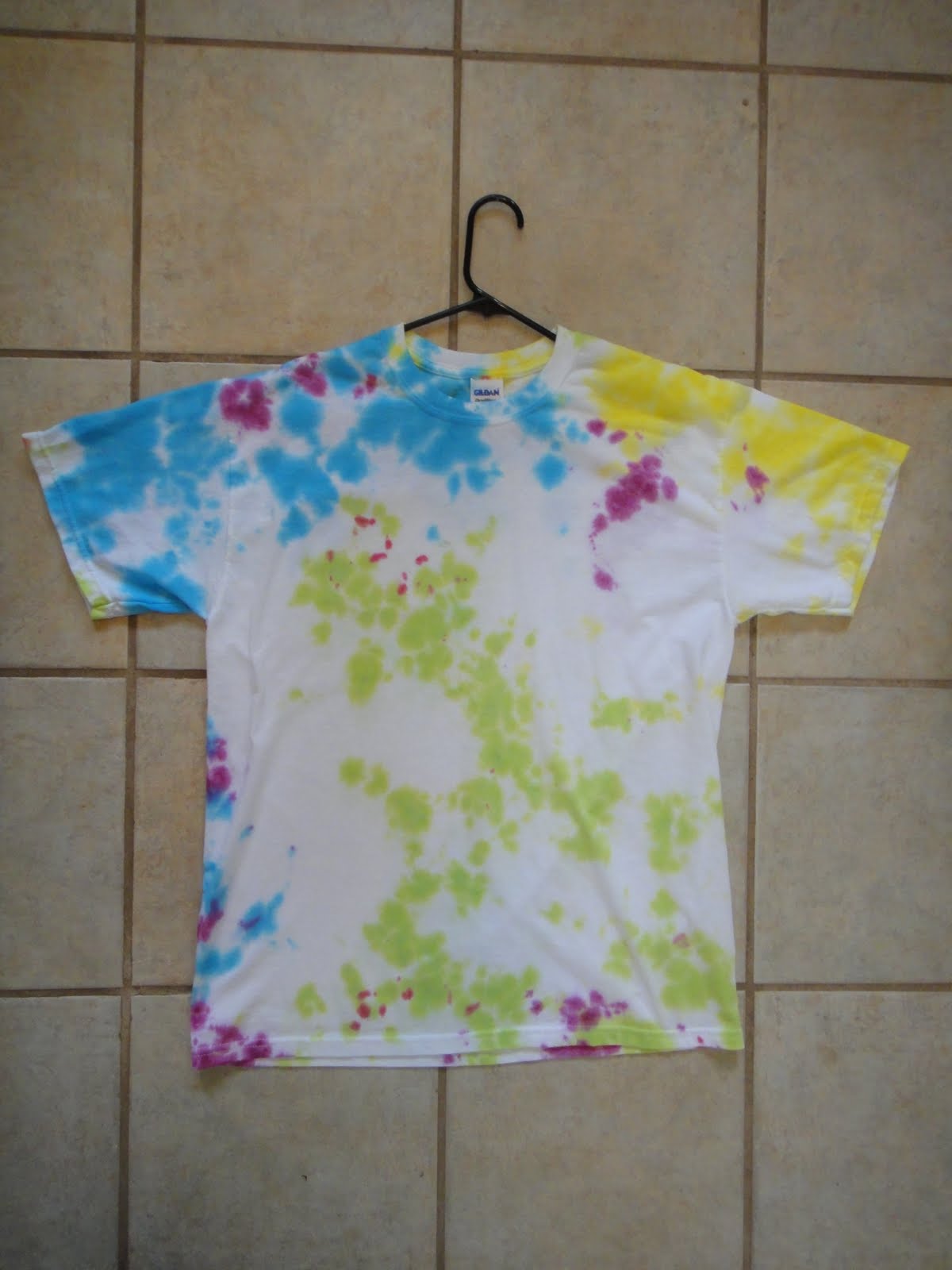
This was my attempt at a scrunch pattern. My mistake was too tie it up with rubber bands, it's supposed to be left loose. For all that, not bad for my first attempt.  


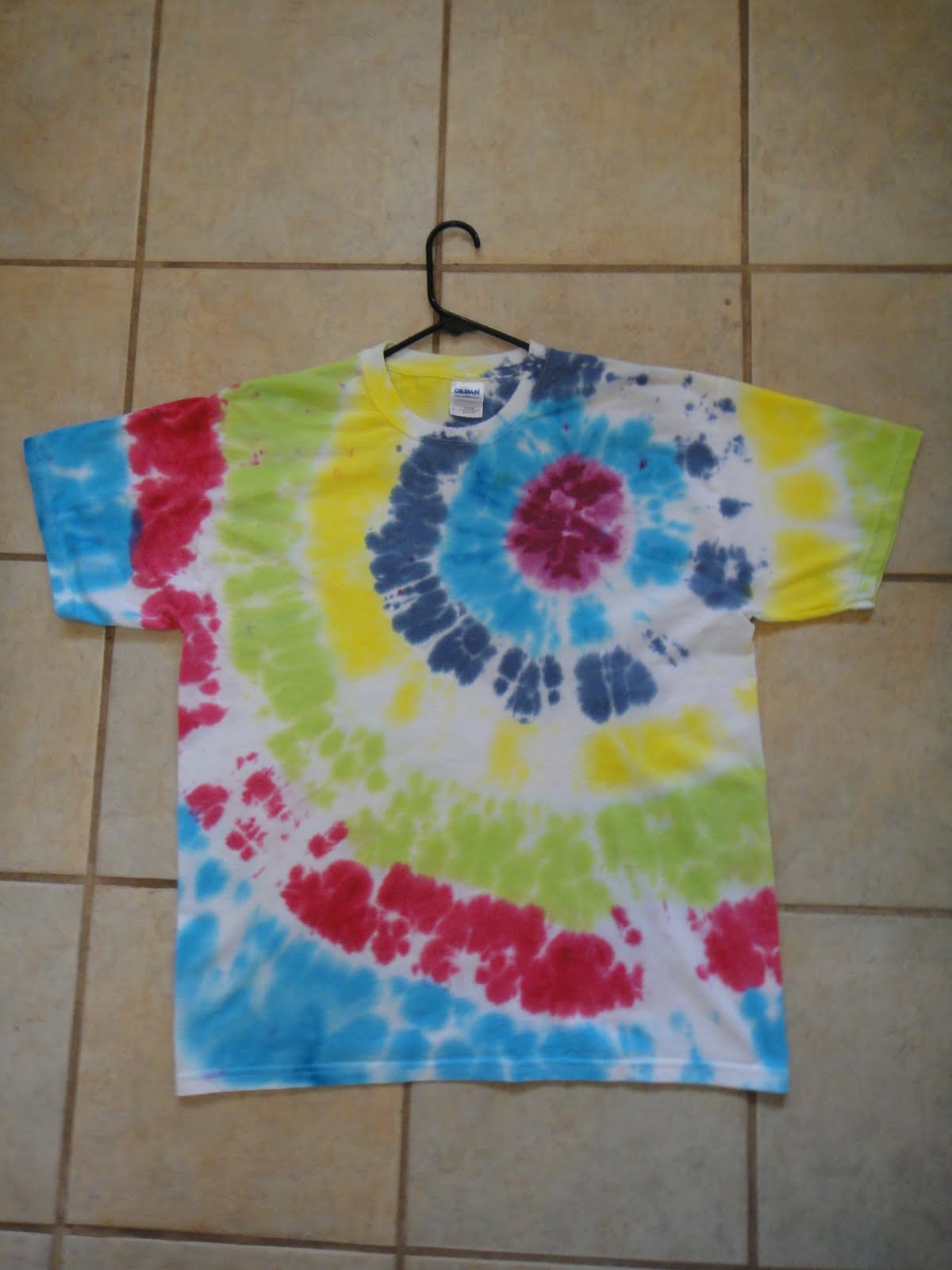
I got a bit too clever with my spiral design, and tried to put three different spirals in. I should have stuck with one or two. I also went too lightly with the dye.


Beth's spiral came out really well, much better than mine. I put the score at 2:1 to Beth, with my bull's eye beating Beth's, but Beth's sunburst beating my scrunch, and her spiral beating mine hands down.

Lots of fun all round, and we have six unique t-shirts that we will never meet anyone else wearing. We've got dye and t-shirts left over, and lots of ideas for other designs. I can see how this could be come addictive.

Other dye colors are available in other kits, and you can mix dyes to make unique colors. You can use any color t-shirt as a base, but white is easiest to show the dye colors as they are originally designed. Be sure to rinse and wash thoroughly several times, and wash separately at first, so as to not have the dyes run into each other or other clothes in the wash.

Followers