Visitor Count

Monday, 2 May 2011

Betting on my Hedge


 On Sunday morning Beth and I drove to Bloomers Nursery to select something for the garden. A couple of months ago I dug up a lavender bush which frankly neither of us liked, and this left a bit of a bare area in front of our porch. My ideas was a small evergreen hedge, and Beth couldn't come up with anything she liked better so that was the plan. On my previous visit to Bloomers (for the apple tree) I'd spotted a couple of pallets of evergreens that would work, labelled $2.50 each, and a sign saying 50% off. $1.25 for a small evergreen seemed like a bargain, so after a wander round the nursery to examine their stock and enjoy the sunshine we loaded up 16 on a cart and went to pay.

It turned out they'd already taken the 50% off so the plants were $2.50 each. Hmm, to me that's false advertising, but we decided to put 4 back and get 12 for the hedge.


I lined up the plants beforehand to see how the spacing would work. Just as well we only got 12, as 16 would have been too many. I tried digging a hole for the first one with a spade, but soon discovered that a claw tool to loosen the earth followed by a trowel to fetch it out worked better. On my hands and knees, with a foam mat for knee padding, I set to.


 An hour or so and a couple of mugs of tea later, all twelve are planted. I judged the line purely by eye, and I think it came out as good as could be hoped. Even if I'd laid a string line and dug holes at fixed spacings, the variation between the plants would have prevented a 100% uniform line. There's loose topsoil down to about eight inches, beneath which there is clay~ish soil and pebbles. I had to did a little way into the clay each time, but hopefully the topsoil is deep enough for happy plants.


By 3pm the hedge is in full sunlight, which it will get until sunset. I wanted evergreens as they should do better in this, the shadiest area in the garden, barring the north side of the house around the toolshed which is a loose pebble surface with nothing planted anyway. This is a dwarf variety, and should retain a rounded shape for each plant, while not growing too tall. I'm hoping they'll grow together over time, but even like this I think they look good.

Thursday, 28 April 2011

Easter Weekend

Lots of little things going on this last couple of weeks:
Last Friday (Good Friday in the UK) we had our new bedroom windows fitted, which required me to be ready to receive the workmen at 8am despite finishing my Thursday's work shift at midnight, though they did not actually appear until near nine. The windows went in within four hours with minimual fuss, and we now have two sash windows with bug screens to allow more air to circulate which will be a boon in hot weather. I had a short evening shift ending at 10:30pm.

On Saturday we had an ant exterminator visit at seven am, as we have had an influx of ants through various parts of the house. I had an afternoon/evening shift at work ending at 11pm, and it was quiet until around 9:30pm, when we had a sudden influx of customers. I had just one colleague keeping me company, so we were pretty rushed just at the time when things are normally quieting down and we start working the day's freight.

Easter Sunday was a chance for a lie in to catch up on sleep, but our cats woke us at 5:30am, hungry after a night's explorations and excitements. Sadly for any egg hunters it had started raining late Saturday night and carried on most of the morning. As I was working again that day (2:30-11:30pm), I totally forgot to eat a chocolate egg or bunny, and they still languish unattended.

On the way to work on Easter Sunday my engine warning light came on...  again. The engine light has first come on the previous Monday, prompting a visit to Oil Can Henry's to see what the problem was. After $160 of servicing, including a change of transmission fluid, the light turned out to be a warning about evaporation from the fuel tank, usually caused by the filler cap not being put on properly by the pump attendant. As you may recall we are not allowed to pump our own gas in Oregon, so I have little control over the filler cap. OCH reset the light and we unscrewed and rescrewed the filler cap, but the light came on again about 50 miles later. Thus I took the car in again on Wednesday, and they reset the light. If it comes on again I'll go to Autozone for their diagnosis.

Also on Wednesday I went to Bloomer's, a Garden Center that had been recommended to us by our neighbor Robert. The Center has a lovely view of the Cascade Mountains, but the peace is ruined by the traffic noise from the I5. It reminds me how lucky (or sensible) we are to live nowhere near any major roads. I bought an apple tree to replace the one we planted last year that expired in the hot June weather when we had a 10 day road trip. This new tree has multiple grafted branches and should grow four different apple varieties.

Robert had previously helped me trim our vines which had grown out of control, and with the space afforded by this trimming I was finally able to remove most of the biggest brambles from the bank, some branches turning out to be over 20 foot long and thicker at their base than my thumb. The cuttings from the vines and brambles are still piled in the garden, being reduced steadily as I feed the clippings into our garden waste bin, and also Robert's which he has lent me.

My laptop started acting up on Saturday but seems OK now. The USB ports failed to recognise my iPod, which can only have been plugged in 50-100 times previously so you can understand its confusion. Happily Beth was able to get it fixed while I was at work, so for now I am able to update my favorite podcasts. Microsoft have also messed about with Internet Explorer and I have had a new version foisted on me on the laptop. They have moved some of the regular buttons from the left to the right of the toolbar, which is like switching the accelerator and brake pedals in a car. Why they felt the need to do this is beyond me, and I wish I could switch back.

Yesterday President Obama released a copy of his long form birth certificate, which ought to finally shut up those people who have been trying to claim he is not legally qualified to be president, such as that sad clown Donald Trump. Of course it didn't, and they just moved onto their next whine, that he didn't get great school grades in 3rd Grade or something. It's all rather sad that the big issues of the day are sidelined for this pantomime.

Tomorrow is Royal Wedding Day, and I can't finish without giving it a mention. BBC America has been running Royal related stuff for a couple of weeks for hours every day, and tomorrow (starting at midnight tonight in fact) there will be many channels showing nothing else. I'll watch some of it (recorded), and would like to have been able to join my family in the UK who are having a viewing party, but time and funds did not allow. The Royal couple seem well suited from everything I've seen, and I wish them every happiness.

Friday, 15 April 2011

One Year in our Sweetwater Home

Today marks the first anniversary of moving into our home in Sweetwater Lane. The weather for our move was better than this year and we have had several wet days, so we were very lucky to have warm dry weather for the move. It really helped, not the least in drying out the carpets after their steam cleaning. Of course we had the garages to pile boxes and other items during the move, so we could have coped with wet weather if necessary.

After our initial rush of purchases for the house and garden we have added very little, the replacement dishwasher and new bedroom windows (yet to be installed) aside. The house is wonderful and rarely a day goes by that we do not remind ourselves how lucky and comfortable we are.

We have kept the house quite sparsely furnished, enjoying the roominess, and our occasional fits of tidying have kept it neat, at least by our standards. Having so much space makes it much easier to clean, tidy and organise than our London home, and having managed this for a year I think we will be able to continue the trend.

Over the next week I'll add some more observations and pictures, but I am in the middle of a six-day week at work, so I'm preserving my energies for that.

Thursday, 14 April 2011

Werewolf Attack


Actuually it's just some scratches I suffered while mounting TVs on the wall at work, and they're not as bad as they look, though I do have another crop on the other arm. A metal mounting bars must have had a burr on it, and unnoticed I rubbed my arms across it several times.

It's new TV season, so we've been busy putting the new models on the wall and taking down the discontinued models. It's a two man, sometimes three man job, as the 55" screens weigh up to 35 pounds, and have to be lifted over shoulder height (and not dropped), hooked onto a bar that we can't see and hence sometimes require a spotter, and when it's all fixed and at the right height (which can take two or three tries) connected to the signal and power feed cables.

That last step is what caused me trouble last night, and led to the scratches. The signal cables we use have five separate connections, two for audio and three for the video feed, and these are not always in the same order on the back of the TV as they are on the cable. The cables are color coded, red and white for audio, and red (again), bluey-green and greeny-blue for the video. In good light I have no problem, but 10pm at night under fluorescent strips, with TVs all around you still playing their feed and blaring in your ears, fiddling behind a dusty panel and looking at everything through a mirror is not good light. Whilst hooking up one TV three others lost their feed, and it took a frustrating five minutes, right at the end of my shift,  to figure out that just because the signal box power light was on, it did not mean the signal box was actually receiving power.

The bulk of the work is now complete and we have a finished TV wall, and have stocks of matching TVs to sell, and can get to those TVs quickly and efficiently without performing simultaneous gymnastics and weightlifting at the top of a wobbly ten foot ladder. Hopefully.

Tuesday, 12 April 2011

A Trip to Cost Plus World Market


It all started with the desire for a decent bacon roll.

I didn't often eat bacon rolls in the UK, but when I did, I wanted a tangy brown sauce to complement the crisp bacon and chewy roll. Unfortunately tangy sauce is not easily found in the US, and after trying various barbeque and steak sauces (mostly liquid sugars with a little coloring), I voiced my desire for some proper HP Sauce to Beth. She immediately got online and found a store in Eugene that carried said HP Sauce.

Cost Plus World Market caters (at a cost) to palates that respond to tastes other than sickly-sweet. You can get Asian, Indian and British foods, as well as many non-edible things. I zoned in on the British aisle, and picked out the HP Sauce ($6 a bottle), adding digestive biscuits, Branston Pickle and some Haywards pickled onions. Again, I'm not a huge consumer of pickled onions or Branston Pickle, but there's nothing quite like these produced or widely available in the US.

Is this the pangs of homesickness? I don't think so, though many ex-pats yearn for various foods or beverages. I haven't really missed any specific tastes or textures much, but it's nice to know I have somewhere I can get a digestive biscuit or a tangy sauce if the inclination is upon me.

Tuesday, 5 April 2011

Spring has Sprung

In the last week we've seen a decided change in the season, with several dry and sunny days, though occasional rain still keeps the lawns green and plants growing. Flowers sprung up, Daffs, Hyacinth, Narcissi and other unidentified things, and our pear trees and cherry trees have blossom starting. Other cherry trees have been in full blossom in other gardens, but ours is a little late. The frogs have been chorusing, and we've heard a woodpecker in the stand of conifers in the field to the North.

We've taken the patio furniture out from its winter home in the gazebo, and even had a brief barebeque on Sunday. The cats are occasionally using the sun loungers. Weeds are springing up everywhere and being tugged out almost as fast, and we have been preparing the raised beds for peas, pumpkins and other vegetables. Beth had grown two sets of seedlings so far and put them out, though the slugs and snails have had their munches on them.

Our biggest disappointment gardenwise is the apple tree we bought and planted last year. Due to the wrong sort of attention or neglect we managed to kill it stone dead, so we plan to get another fruit tree to replace it soon, probably another apple tree but with mixed varieties grafted on the same trunk. 

Tghe rainy season is definitely easing and before long we'll miss it, as we'll have to do a lot of watering to keep everything green, with a water bill to match. Fortunately the heating bill will be dropping at the same time, so our monthly expenses even themselves out.

Thursday, 31 March 2011

My Handheld Game Consoles over the years


Behold my collection of Nintendo and Sony handheld game consoles. The original grey Gameboy from 1989 with several of the original games I bought at the time is at the top left. There was a Gameboy Pocket, smaller and lighter, but I never got one as it played the same games.

The Gameboy Color added (guess what) color to the display in 1998, but the graphics and cartridges were otherwise very similar. It wasn't long before the Gameboy Advance was released in 2000, so the Color had a short shelf life. The original Advance was an ugly shape, and fortunately an upgrade was on the way.

Nintendo launched the Gameboy SP, an improved version of the Advance console in 2002 and the SP was a tremendous improvement on the original. With a back-lit screen, built-in rechargeable battery, and folding to protect the screen so carry cases were unnecessary, this is my favorite of all the Nintendos, which is probably why I acquired multiples.

The Micro was a sidebranch to the Gameboy tree in 2005, playing the same Advance games as the SP. It couldn't play the original or Color games, which was annoying. The screen was smaller than the SP screen, and as the SP wasn't that large to begin with it wasn't a big success. I bought one fon an impulse, but it never got much use.

The Nintendo DS dropped the Gameboy name in 2004, substituting two screens, one a touchscreen activated with a  stylus, and another rather ugly design. It also reduced the size of the cartridge to something not much bigger than a camera SD card. Some games work really well with the stylus, but in many it's an annoying nuisance, and actually rendered a few unplayable to me. Fortunately the DS lite came out in 2006, a much tidier design, with the same size screen. The DS Lite could still play all previous games right back to the original titles too, thanks to having two cartridge slots.

The DSi added a camera, which I've never used on my DSi XL, but got rid of the second cartridge slot so it could only play DS games. The XL has a 93% bigger screen than the DS, and importantly for me the battery light goes from green to blue instead of red when the power is low. In almost every previous generation (except the Micro) I've either had warning from Beth when the power was dying, or a sudden blank screen, very annoying when you haven't saved your game recently.

The Sony PSP at the front is not the first generation, but there are far fewer games available for this unit, and most of the ones I want I buy online as they are not usually titles carried in stores. I resisted buying one until Final Fantasy Tactics "The War of the Lions" came out for this, as tactical RPGs are my favorite style of game for handhelds. Thus my library of Sony PSP games is much smaller than my library of DS games, but there are some gems there which I could not play any other way. The UMD disk is a rather clumpy device to load and I broke the back on one PSP when I dropped it while putting in the disk. You can buy movie disks to watch on the PSP, but I've never bothered.

Wednesday, 30 March 2011

Buying into the Digital R-Evolution

A few weeks ago at work I processed the contract for a Smartphone for a young gentleman, whose bill was going to be around $80 a month. My total talk and text usage last year cost me $30, about $2.50 a month, and my phone cost $20. This got me thinking about the various digital consumer technologies that have appeared in my lifetime, and my relationship with and adoption of them.

Cellphones aka Mobile phones: I've had four cellphones in my life. The first, a Phillips, I soon sold on to my parents and got another. I was on a Orange plan, because it was the only Pay-as-you-Go plan that did not delete your unused minutes after a certain time period had elapsed. My initial £50 of airtime lasted over a year. My second phone, a Nokia, set the pattern for getting Nokia phones, and every phone I've had since was a Nokia.

That first Nokia phone had the fun feature of being able to compose your own ringtones using a special shorthand, but unfortunately didn't have a vibrate function, and the ring was very quiet. I missed most of the few calls people made to me, simply because I didn't hear the ring when the phone was stashed in an inside coat pocket. This ultimately led to the loss of this phone when I couldn't find it, and couldn't hear it ringing anywhere in the house. Just before we moved to America I found it in the a boardgame box, where I must have tidied it away. The loss of this phone led to my third cellphone purchase, a very similar Nokia 3210,  much slimmer and lighter (technology had moved on), with a louder ring and a vibrate feature (hurrah) but also no compose ringtones feature.

That phone I still have, but needed a new one when we moved to the US, and Beth found a T-Mobile plan where you get 1 year's airtime and 1,000 minutes for $100. The phone was a separate purchase, and I got the cheapest lightest $20 Nokia I could find. 1,000 minutes doesn't sound a lot to people who go through more than that in a month, but I used around 300 minutes (total talk and text) in a year. By adding $10 to my account I was able to carry over the unused minutes, so I started 2011 with 800 minutes of available talk and text time.

I use my phone, as I have always used cellphones, for emergency contact only. I can't talk on the phone at work or driving, don't need to at home, and it's main use is so Beth can text me if something comes up (e.g. need to buy milk or cat food).

Smartphones: A smartphone is a cellphone with internet access provided through a 3G cellphone network. Some people love them, such as the $80 a month gentleman, but I haven't seen the need as I have internet access at home. 3G is defined as a certain speed of information transfer, and 4G is already on the way in.

Video Games: I fondly remember the day (sometime in 1977?) my father came home with a videogame console. He is prone to spontaneous bursts of generosity like this, for I can't recall either myself or my brothers asking for one (he may remember differently), but we spent many happy hours playing Pong, Hockey, Skeet Shooting and the like. The games were all built in, and limited to white graphics on  black background. A year or two later I saw my first Space Invaders ArcadeGame at a Youth Hostel on the shores of Loch Lomond, in color, though the colors were just colored filters stuck to the screen.

Home Computers: Sometime soon after, still in the early 80s, my mother bought us a BBC micro computer, one of the first generation of home computers.  The idea was, I suppose, that we would learn to program computers, but as I recall we mostly played text-based adventure games like Snowball, and a fantastic open-ended space adventure game called Elite, with wire-frame graphics. At school I was just too old to learn on the first generation of PCs, and my early computer experience came on the school's mainframe accounts computer, far from ideal but a lot better than nothing.

At University my access to computers was mostly limited to using the Library's system to access Reuters for news stories. In my final year someone bought a computer to write their essays and assignments on, but for personal organisation the FiloFax was the thing, not a laptop or smartphone.

After University I grew closer to my eldest brother Richard as we shared an interest in gaming, comics and Manga, and we spent most Saturdays together, the mornings at comic shops, the afternoons and evenings at a Roleplaying club. We also worked together as he got me a job where he worked at a small magazine publishing company, which used Apple computers. He it was who introduced my to the Internet, and got me my first email account through a company called compuserve.

Nothing has impacted the way we run our lives more than the home computer. Apart from video games, I use mine for spreadsheets, organising my digital photos, music, video files, and of course internet access, without which you would not be reading this. The fact that you are reading this suggests you have also adopted a computer as a regular part of your life.


Portable Game Systems: One Saturday in the early 90s my eldest brother and I went to a game shop and bought ourselves Nintendo Gameboys, with 4 or 5 games each. In addition to Tetris that came with the unit, I recall Battle Bull and Nobunaga's Ambition as two of those initial purchases, and I still have those games and all their packaging. Other friends had gone for the Atari Lynx and Sega Gamegear, but these burnt through batteries at an eye-watering rate, and we were happy with the simpler graphics but better battery life. My middle brother had a handheld space invaders style game some years before, and at the time it was a great unit, but it only played one game. The Gameboy allowed different games to be played with different cartridges, and the latest Nintendo handheld console, released earlier this week, now sports 3D graphics.

I've continued my interest with videogames mostly through Nintendo handheld devices over the intervening years, and also have a Sony PSP (short for Play Station Portable). I used to have a Sony Play Station, followed by a Play Sation 2, and for a year we had a Nintendo Wii, but all these consoles had to go when we moved to the US and have not been replaced. We play PC games at home, and I use my Nintendo DSi and Sony PSP, and Beth has a Nintendo DSi and uses her iPod Touch to play solitaire.

eBooks: An eBook is a dedicated device for downloading electronic books. There are various ones about, the Nook and Kindle being popular, but I've not bothered to buy into this technology. I have shelves full of books already when I want to read, and prefer the feel of paper in my hand and turning real pages. Besides this most of the books I read are for reference, and not available as digital copies anyway.

HDTV:  I'm old enough to recall when a TV which had a dial for tuning to the three available channels, and when I bought my own TV in London, had the same ex-rental 24" screen cathode ray tube TV for over 15 years. Arriving in the US we needed a new TV, and by 2009 you couldn't buy a non-HDTV flatscreen even if you wanted to.

HDTV stands for high definition, which means the TV displays more horizontal lines (720 or 1080) than a conventional tube TV (which had around 525 lines for NTSC, the US standard, and 625 for PAL, the UK system).  However unless you have an HD input (via terrestrial broadcasts, cable, satellite or Blu-Ray player) the picture you see is not HD. At present the cable and satellite companies charge extra for HD channels so we don't bother, and Blu-Rays are still generally more expensive than DVDs, so we haven't invested in one of those either. I'm sure that in time HD will become the standard, but until it does we may have an HDTV, but we're not usually watching HDTV. When we watch DVDs the picture is upscaled to near-HD quality by some technical wizardry in our DVD players.

Cable and Satellite Broadcasting: Alongside HDTV, the way we receive broadcasts has changed. In the UK I had cable for a while, but felt I was paying a lot for not watching much and eventually dropped it. Beth and I lived with a Freeview box for the rest of our time in the UK. A Freeview box is a set-top box purchased for around £30 that is capable of receiving many more channels (around 30) than the terrestrial broadcasts alone (five channels by the time we left the UK). Once you've paid for the box your viewing is free, except for the annual TV license fee. We had a freeview box with built in hard drive, so we could record hours of TV and watch at our leisure. We found that we recorded more than we had time to watch, but it was a very useful device.

In the US there is no Freeview system, but unless you are happy with the basic 6-8 local digital broadcast accessible through a digital antenna, you need to subscribe to cable or satellite TV. This is going to cost you an arm, and if you want HD channels a leg too.

3D TV: This is starting to come in, and customers ask me about it occasionally at work, but there are very few 3D sources, so there's not much you can watch in 3D. There's currently about 60 3D films available, and a handful of channels. To me it's a gimmick, and when a movie comes out in 3D I only watch the 2D version at the cinema anyway. You still have to put on special eyewear to watch 3D (also assuming you have a 3D TV and a 3D source), but the technology is being developed to do away with this annoyance. Will 3D become the standard some day? I hope not, but if it does it's years away yet. Yesterday one of my colleagues proudly told me about his 3DTV purchase, and his library of eight 3D titles.

Record Players, Audio Cassettes, CDs, Mini-Disks, Sony Walkman, MP3 players, iPod, and iTouch: I never had many vinyl records of my own (though my parents had a family record player and collection), because by the time I had money to spend on such things tapes has already taken over. At University I used audiotapes to both play and record, and bought my first tape-to-tape cassette recorder with a win from the Premium Bonds in my first year away from home, but CDs and other audio options were already coming in.  Prior to cassette tapes I mostly listened to the radio for aural entertainment, on a clock radio that woke me every day for school.

I resisted CDs for a long time, mostly because I had invested so much in audiotapes, but also because CDs were very expensive. The Walkman was a portable cassette playing device, and later models had radio receivers as well, so now we could have music and audio entertainment on the move. I went through several Walkmen (and similar devices) in my post-University years, because they received a lot of knocks. One problem was that, though the player was not much bigger than the cassette inside, you would need several cassettes to have listening options.

Car stereos have developed alongside Walkmans and portable CD players, illustrated by the fact that my wife's 2002 car has a cassette player, while my 2007 car has a CD player with auxiliary input. This means I can plug an MP3 player straight into my stereo, while Beth uses a device like a cassette tape with an audio jack hanging out of it on a wire.

Alongside CDs, my wife and I both briefly and independantly (as we didn't know each other at the time) had Mini-disk players. The advantage of these over CD players was that you could record your own (until home computers gave that option for CDs), and indeed few commercially available pre-recorded minidisks ever existed. The disks were smaller and better protected than CDs, so easier to carry around.

I recorded many of my old cassette tapes onto minidisk to preserve them and make them more portable, but before long another option became available - MP3. Actually MP3 is only one form or digitally recorded audio file, but has become the quick reference name for any form of digital audio file. Digital media has the massive advantages of reproduceability and portability, though some say the audio quality is not as good as CD, and CD is not as good as vinyl. I really can't hear any difference.

When I invested in my first MP3 player I wanted one that could record as well as play, as I am an amateur musician. This wrote off all the iPod offerings, but (after a friend's recommendation) in 2002-3 I bought an iRiver iHP-140. This machine had a 40GB hard drive, a massive amount at the time, so it could hold a LOT of recordings, but more importantly I could transfer my cassettes, minidisks, and CDs onto it, and after a little editing, have them in an even more portable and robust form. I spent much of the next 5 years copying my precious tape, CD and mini-disk collection via the iRiver, editing and saving the tracks on my PC, plus a back-up external hard drive.

This wasn't part of any bigger plan, other than saving material in digital (and thus more transportable) format, but when Beth and I decided to move to the US it was much easier to carry my entire audio collection in a device that fit in my pocket, or clipped onto my belt. By that time I had replaced the iRiver with an iPod (though I still have the iRiver as a backup), and I carried the data in three places, the iPod, an external hard drive, and my PC's hard drive. I chose 160GB iPod Classic for its storage capacity, and I use it every day.

Digital Cameras and Camcorders: Digital photography has greatly impacted my photographic habits. It used to cost about 25p to print a single picture, and until it was printed there was no knowing if it was worth printing. I spent several years in the '90s and '00s doing long distance walks and conservation holidays, and during these years a digital camera would have been very welcome. Unfortunately I didn't have one, but soon after Meeting Beth for the first time (June 2003) I was converted to the idea, and bought my first digital camera, a Pentax Optio S4 (after seeing Beth's one). The delight of this model was that it fit into a shirt pocket, so there was rarely an excuse NOT to have a camera handy.

 After a few years and several drops the S4 started playing up and was replaced by a Pentax S6, and when that started playing up a year ago, Beth and I bought Sony Cybershots. That is, Beth decided to get one, after weeks of painstaking online research, and I jumped on the bandwagon. Thus we have matching cameras (one black, one silver) which also act as camcorders. I bought a separate Panasonic camcorder in 2009 for a trip to France, but have never been good at making videos except for special occasions.

VHS, DVD, Blu-Ray: I was probably fortunate that I never had time to build up an expensive library of VHS videotapes before DVDs took over as the primary medium for purchasing films and TV shows. It was no real hardship to shed the few videotapes I had when we started planning our move, and copy the special ones to DVD. DVDs are artificially regionalized (via codes on the DVD and software in the DVD player) to prevent the global marketplace from being truly free (because truly free markets apparently don't really work), but it is easy to either buy a de-regionalised DVD player, or de-regionalize one yourself. We've done both in our time, because our DVD library has always been a mix of US and UK titles.

Blu-Ray is another matter, and we haven't yet made the step up. Just as people who have an extensive VHS library hate having to upgrade to DVD and resist the cost, trouble and frustration, so we are for now ignoring Blu-Ray. Blu-Ray does give better picture sharpness, but at present there's still an additional cost of around 15-20% over the cost of the same movie on DVD, and in any case we don't buy many new titles. No doubt we will one day buy a Blu-Ray player and start buying Blu-Rays, but as long as DVDs are still freely available and cheaper we'll stick with those.
GPS: We didn't buy a GPS navigation system until we arrived in the US to stay, but after that we both bought units for our cars and use them for many non-standard trips. Having experience of Garmin from a trip to Scotland, sharing the driving with my brother, we stuck with what we knew and both got Garmin units. You can pick up a GPS for a car for $79, though we invested a little more to get more features, and the units have served us well and features in this blog several times.

Streetlighting

We enjoy seeing the stars at night, and London has two disadvantages for the casual stargazer. First, the tall buildings physically blocked the view, and second the street lights blinded the eye. There is also the indirect glare of badly designed street lights throwing light up into the night sky.

Eugene is far, far darker than London, both on the main roads I drive regularly like River Road,  Beltline and Northwest Expressway, and on the local suburban streets, but light pollution is still a problem. In our cul-de-sac the street lighting is provided by the houses themselves, with no lamp posts. This was a canny move by the city to make the residents pay for street lighting, but it affords us the opportunity to reduce the problem.

Our house has two lanterns, one either side of the garage door, which happily for us were set to hold three  small bulbs each. This was probably a modification by the previous owners so they could use colored bulbs at Christmas, as other houses in the street can only fit one normal-sized bulb in each of their 2-3 lanterns. We recently switched to leaving just one bulb on in each lantern, and the total 8 Watts of light is ample to light the house at night - particularly as my car is fitted with lights anyway, and I've never yet failed to find my way home for lack of light.

That fixed our problem, and our neighbors on one side have taken their bulbs out entirely as a trial, and their house is still visible at night too. The other neighbors haven't yet been approached, and they have a couple of hundred watts burning away all night.

A quick calculation shows that using 3 x 60 watt bulbs to light a house for 8 hours a night for a year uses 520 KWhours more electricity than our 8 watt glare. From EWEB's website (our energy provider) this would be about $62 a year.  That's not going to break the bank alone, but adding up savings like this by turning off unnecessary lighting and other appliances all helps.

Our primary motivation is not really the cost, of course, but cutting down on light pollution.

Saturday, 26 March 2011

Monsterous Trucks

Americans love a big vehicle. I took these photos back in early April 2010 just before we moved house but never got round to posting them.


This truly monsterous truck caught my eye, as I trust it has now caught yours. The owner was sitting on his balcony as we took photos and we chatted a while. On one level I admire these sorts of trucks, but with gas now topping $3.70 at the pumps in Eugene, this one burns a dollar of gas every 3 miles. If I drove one of these, my first hour at work each day would just pay for the commute. The car behind is a normal-sized saloon, and barely comes up to the top of the bumpers.


A side effect of over-bigging your truck is that it won't fit in the garage. We like to park a car in  the garage, and it's easier for unloading shopping. Not everyone uses their garage as a garage of course, but it's nice to have the option. This picture and the two below were taken on a walk round a subdivision north of our old apartment complex.


The advertisements for trucks such as these emphasise their ability to pull tree stumps out of the ground, or haul huge rocks or a spare truck engine with minimal effort, but these are not common endeavours for most owners. For daily life, commuting, shopping trips and so on, I can't help feeling that they're impractical and unnecessary. The pick-up bed is usually empty, and as it's also open to the elements in most cases, still isn't used in bad weather for hauling furniture or a new 55" flat screen TV.  Far cheaper and more practical to hire a U-Haul van for those rare occasions when a big haulage space is required.


The covered pickup such as this one is slightly more useful, at the cost of hauling around yet more weight, converting the truck into a big station wagon (estate car). This one looks too long for the garage.

Tuesday, 15 March 2011

Shoes

Bunions, corns, cracked heels, athlete's foot, hammer toes, in-grown toenails.

Modern shoes, and particularly women's high-heeled shoes, are sadly more a product of fashion than practicality or necessity, and are rather bad for feet, reducing them to clumping appendages rather than moving muscled pieces of nature's sculptured engineering. Who has not enjoyed the feeling of walking barefoot in grass or sand, and regretted having to don some hateful stiff-soled footwear afterwards? Or slipped off their day shoes and put on soft slippers with a sigh of relief?

Actually the problem goes further, as poor fitting or designed shoes affect balance and posture, and cramping feet inhibits development. You can read more about the medical research here , and the effects of shoes on your feet and the benefits of going barefoot, or as near as is practical, here, here, here, and here .

I once worked with a South African girl who spent her youth playing and running barefoot on a farm. As a consequence her toes were spaced out rather than curled and clumped together as toes become in shoes. She wore open sandals when she had to wear anything, and would slip those off under her desk at the first opportunity. However it's not really safe to walk around barefoot in a city environment, especially if one hasn't been accustomed to do so from birth, so some form of foot covering is still desireable - some alternative to traditional shoes that offers protection from cuts and scratches, but allows the foot to move as nature intended, for the toes to spread and grip, the arch to be supported by muscles, the ball and heel to work together as cushions, your toes to push you forward rather than the curve of your shoes.

It is in the slightly-Hippy nature of Oregon that an alternative to traditional shoes should be manufactured locally, and in the open-minded nature of Beth that she should learn about this and give it a try. A couple of months ago we visited Soft Star Shoes, about an hour's drive North in Corvallis. Here over 25 years ago they started making soft moccasin-style shoes for toddlers and children, and due to public demand expanded the range to include adult sizes. Beth bought one pair on the spot and ordered a second pair (which they didn't have in stock).


Behold the soft star shoes, which Beth has worn almost every day since. These moccasins are soft and pliable, allowing your feet to breathe and do more of the work of walking. It takes a week or so to adjust, but Beth stuck with it and now only wears normal shoes for gardening and in the woodshop, and then only to save her Soft Star Shoes from excessive wear and tear.

Where Beth leads I often follow, and yesterday I drove up to Corvallis and bought a pair for myself, ordering a second pair (with slightly thicker soles for trail walking) to be posted to me when ready.

Sunday, 13 March 2011

Karate

Since September last year Beth has been attending a twice-weekly hour-long class at the Eugene School of Karate, located perversely in Springfield, but only fifteen to twenty minutes drive from her office and our house.

Beth was first introduced to Karate when she, her mother and brother all started together when she was around ten, but she was on her own in the kids' class while her brother and mother were together in the adult class. As a result she dropped it before gaining any belts.

She started again in College, and gained a yellow belt in six months, but stopped at that point when academic studies and other interests took precedence.

She's been wanting to get back into Karate ever since, but the discomforts of travel and timing in London prevented her while we lived there. Her two options were a school in Southall which would have required leaving work early, or in King's Cross which would have resulted in getting home very late. The curse of trying to do extra-curricular activities in London is the combination of hanging around for the class to start while everybody arrives, and the discomfort of getting home again afterwards by public transport which can take a couple of hours on a bad day.


Karate has many different branches, but they all start with a White Belt for novices. Beth's previous Yellow Belt was in a different style so she started again at White in September. Here she is sparring with a regular partner, before getting her new Yellow Belt in December.


A couple of weeks ago I was available to go along with her and take some photos and video of her training, and Beth was able to use these to help with technique. This evening she taked the exam for her Blue Belt, but unfortunately I'll be at work and consequently unable to watch.

Saturday, 12 March 2011

Beth's Woodshop


One of the reasons we fell in love with this house was the extra double garage building it offered. The first owner was a builder, and when the plots were still being drawn up he managed to extend the property to allow space for the extra garage, which he then built around 2005. The extra building adds a little more privacy to our garden, and houses Beth's Woodshop below and a spare room above which houses my Playmobil collection.

Most Americans who want a woodshop or workshop, including our immediate neighbors and others in the subdivision, have to sacrifice their regular garage or some part of it. Our separate building keeps the noise and dust away from the main house, and frees up the regular garage to be... a garage.


With her usual premeditation and efficiency Beth started planning the shop layout from the day we moved in. Using cardboard from our packing she laid out the pattern of where machines would go for maximum access and ease of moving pieces from one machine to another. In the picture above there's just one machine in place, a lathe generously donated by our friend Mack, and driven home from Grand Junction in Colorado. 


Beth added new machines as they became affordable (there are always sales and offers going on), checking out garage sales as well for possible additions, until the woodshop is now fully equipped. There's a drill press, joiner, planer, scrollsaw, tablesaw, band saw, mitre saw, grinding wheel, air filter, dust collector, the big lathe and a mini lathe, router, a belt/disc sander, oscillating spindle sander, shop vac, and two workbenches, and some shelves for storing wood pieces and projects.


All this makes it much easier to put together a quick project. One of Beth's early ones was this bottle balancer, a bit of fun and a conversation piece for dinner parties.


Of more practical use to us (as we don't drink wine) is this cap stand, made entirely from scrap wood in four hours. Beth looked one up on the internet and designed this from the pictures.

Thursday, 3 March 2011

New Kenmore Dishwasher

For the last year we've been living with a Frigidaire Ultraquiet 111 dishwasher, that came with the house and was no doubt the standard fit ten years ago when the house was built. It's never been impressive, occasionally leaving gritty deposits on glasses and plates, and it's hard to recognise when rinseaid needs to be topped up as there's no visible indicator. A small orange LED is always on no matter what the machine is doing. It may be that the fitted appliances in the house are starting to wear out (our neighbour's microwave gave out recently), or it may be that this was never a very good model. I read some online reviews and have never seen so many damning comments on an appliance before.

Thus we went to Sears to check out their dishwasher options. Beth, as usual, had done some prior online research, so it didn't take long to select a Kenmore Elite that suited our needs and pocket. Sears have regular sales, and we time our purchases to match. We bumped into our neighbours there, choosing a replacement microwave, which I helped fit last week. With the current sale prices , and a points reward from last year's purchases (chest freezer, mini-fridge, washer and dryer) it came to around $685 including installation and removal of the old dishwasher.

Today is the great installation day, and having been woken soon after six am by a playful young cat, I decided to uninstall the Frigidaire myself and get things ready. Two screws held the the dishwasher to the underside of the counter, and once those were removed it was easy to slide the old unit most of the way out of its niche. There are three connections for a dishwasher; electric, hot water, and waste water. The first was hard-wired which surprised me as in the UK I'd expected a plug and socket, but maybe the power required is too much for the regular ring main. It was easy to locate the specific trip fuse for the dishwasher (our fuses are tucked in a garage wall), and at last the light on the front went out. Then I needed to remove a baseplate from the front of the washer to access the mains wire, but once I could see what to do it was quickly disconnected.

The hoses for hot water and waste water were simpler, being connected under the sink. Hot water comes in via a steel wrapped hose which has a shut off valve and required a 5/8" wrench (spanner) to undo. The waste water goes out through a translucent white hose connected with jubilee clips (not sure what the US term is) each end. I removed both hoses and stored them in the sink for possible re-use.

At this point Beth came down ready for work and helped me carry the unit into the garage. I wanted to check whether we'd need to remove any doors in the utility room, but at a standard 24" width and depth there was plenty of room. A dishwasher is mostly an empty box, much lighter than a  fridge or stove of the same dimensions would be, so we got it out without too much fuss, though there are no handholds at the back of the unit and Beth had a little trouble gripping it. A bit of water also spilled out on the kitchen floor as we moved it, but with some paper towels we were able to prevent it running into the dining room carpet.

An hour or so later the installer arrived with the new machine. He was very pleased to see the outstallation already done, and had the new machine in and connected up within an hour.

Our new dishwasher is a Kenmore Elite, with a better washing action, better water and energy efficiency, and no stupid light except when it's running. The old unit had a dial to activate but this one has buttons, one button to select standard cycle, and toggle buttons for the various options.

Tuesday, 1 March 2011

Doing a Blinding Job

Our dining room has a 6' wide patio window which allows in a huge amount of light, but a little too much in the Summer, so we wanted to fit some blinds. There was already a track fitted, but the previous owner had taken the actual blinds with them, so I needed to find some new ones that would fit.

A quick trip to Jerry's, our local family-owned DIY superstore, and I found the variety I needed. These plastic blinds come in packets of 9, but oddly our blind track had 29 hooks, so I'd need 4 packets to do every hook. I decided to get 3 packets and leave one hook empty at each end instead. There were two plain versions at $9.99 a packet, white and alabaster, and a number of more fancy textured ones, but as the textures tripled the price again my decision was simple. White or Alabaster? White would show every speck of dust, so (with Beth's advice) I chose Alabaster.

The next decision was whether to have the blinds cut down. Jerry's offer this service onsite so you can have the blinds fit any length of window. The packet specified 84" long, but I'd already measured the drop on our blinds at a little over 82". Aha, but these blinds are not really 84" long, they're designed to fit an 84" window frame. No need to cut them down then, so I purchased 3 packets and tootled home.

After a little puzzlement over how to remove the blinds from the aluminium hook of the packaging, I got the blinds free and started hanging them. The job couldn't have been easier, just push each blind into the hook fitting until it clicks into place and onto the next one. In less than 5 minutes the job was finished.


Blinds fully closed


drawn but open


tucked away


Half drawn


And that was that. I should have done this a year ago, but I was expecting the job to be harder.

Monday, 28 February 2011

Kayaking III

My third Kayak outing took me to the Fern Ridge Reservoir a few miles West of Eugene. This is a very quick and easy drive from our house, so despite some lousy weather I set out a few days ago to try it out.

By now I'd got my preparation routine sorted. With car in garage, put kayak on top and strap down (straps and roof-cushioning system stored in kayak when not required). Lifejacket and paddle in trunk. Get any snacks/refreshments ready in backpack. Squeeze into wetsuit, wetsocks, new speedo footwear, and put a loose button down shirt over the top (for disguise). Hop in car and drive to location carefully. The roof-securing system is excellent, but the straps do vibrate in the wind so there's an exciting buzzing noise at anything much above 20mph.

 I was headed to Orchard Point recreation area on the NE corner of the reservoir, but was foiled briefly by a closed gate. However the next gate along was open, so I drove in and parked in my preferred position near a wooden footbridge. The ticket machine was sealed in black plastic bags but with no sign, so it was unclear whether parking was currently free or forbidden. I chose to believe the former, and unstrapped the kayak and started heaving it towards the water. Here my inexperience kicked in. I was about 50 yards from the water's edge, and hadn't realised that most of those 50 yards were sucking mud.

I struggled along for about 10 yards, then realised I would never cover the whole fifty without losing a shoe or myself to the mud spirits, so I changed direction and headed for some wooden landing stages instead. These were resting a couple of feet above the water's surface, but afforded me a solid surface from which to launch. The water was only inches deep however, so as soon as I sat in the kayak I was stuck on the mud again. A minute or two of adjustment, mostly putting my feet in the icy water and shoving the kayak forward, got me moving. Still in only a foot or two of water, my paddles were pushing on the muddy bottom as much as paddling, but eventually I cleared the bottom and was able to paddle normally.

My launching site was sheltered behind an island, and I could see slightly choppy waves where the wind was whipping across the lake from the south. I headed into that regardless, put the nose into the wind, and paddled away. The waves occasionally sloshed over the nose and dumped a cupful of water into my lap, and the paddles dripped further lakewater across my legs. I've already ordered a splashdeck to relieve this problem, but for now I had to accept some dampness. The waves here were nothign compared to sea waves, but they were a good test for my paddling skills and the kayak's wave-worthiness. The trick here is to time your paddle strokes with the waves so you aren't paddling thin air, and to keep the kayak headed into the waves for minimum splash. 

I paddled out into the wind for a few minutes, then turned about (happily with no feeling of even a possibility of capsizing) and went back to the shelter of the island, then repeated the process. That was enough for today, as my hands were getting numb in the chilly wind and wet, so I headed back and looked for a place to land.

Viewed from the lake it was now obvious that the best place to launch and land was a slipway some 200 yards from where I had parked, so I paddled across to that, but found myself stuck on the bottom about 15 yards from the shore. Stepping gingerly into the water I dragged the kayak to dry land and a few feet up the slipway, then feeling a trifle foolish walked self-consciously back to the car. First off I wasn't sure if I should really be there at all, and a bright blue lifevest with blue and black wetsuit underneath does not make one blend in, but there was nobody around (or at least nobody came to shout at me), and I quickly got the car up to the top of the slipway and loaded up the kayak. Now with numb hands and frozen feet I sat in the car for a few minutes and guzzled some tomato soup which I had brought in a thermos flask, also letting the car engine warm up and blow some hot air onto me. A wetsuit is so snug that it's difficult to get out of in a dignified way, especially as one is naked underneath. You peel it off and it turns inside out while you do so, and part way through you are starkers with you feet still trapped in the suit. So far I have chosen to sit on a towel to drive home and change there, where a hot shower and dry fresh clothes complete the process.

Back home I discovered that my annual parking pass had arrived, so I am now displaying that on my windscreen, and can park at any of the Lane County Parking places without worrying about day fees. The lake is much more hospitable, and much fuller, in the Spring and Summer, so once we have the worst of the Winter behind us I will revisit the site for a longer exploration.

Sunday, 27 February 2011

Kayaking II

Eager to try my kayak on the Willamette River, on my next free day I loaded up the car and drove to Whitely Landing, a small carpark with river access just a couple of miles away. It was fairly cold, but a wetsuit keeps you warm and a lifevest on top cuts out most wind. The carpark was deserted (good), so I was able to unload the kayak and get ready without feeling judged. This was my first live attempt at getting the kayak onto and off the car for real, and it's not the most dignified activity.


After a little huffing and puffing the kayak was ready to get on the river.


Once out on the water it became obvious that I wouldn't be able to make much headway against the current. At this time of year there is a huge volume of water coming downriver, and as soon as I left shelter of the bank I started drifing downstream too. Paddling hard and staying as close to the right-hand bank as possible, I was able to get about 100 yards upstream. Here a tree leant out over the water, forcing me to go back towards the fast-flowing center of the river, and paddle as fast as I could, I couldn't make headway. As soon as I put the side of the kayak to the current I would start drifting downriver again.


Holding onto a branch I took this picture to show I'd at least been on the water. Then it was time to drift back down to the landing ramp.


Back on dry land, ready to pack up. When the water level is lower the river should run slower, and allow me to get past that tree and explore further upstream. An alternative is to have Beth drop me off upstream and paddle down to this landing ramp, having previously parked my car here so I can load up and drive home without Beth having to come and fetch me.

Apart from the Wilammete and McKenzie rivers with all their park and lauch locations, there is also the Fern Ridge Reservoir (aka Fern Ridge Lake) not far to our west, and this was destined to be the site of my next kayaking adventure.

Terwilliger Hot Spring

There are several hot springs in Oregon, a reminder if one is needed that we have volcanic activity in the mountain ranges nearby. A couple are only an hour's drive from Eugene, so having a mid-week day free I set off to investigate Terwilliger (aka Cougar) Hot Spring.


The road for the last 200 yards is badly potholed. I hope my parking fee helps pay for some roadmending.


A Ranger Booth at the start of the trail leading to the pools is manned in the Summer, but empty in January. There is a $5 fee which goes towards maintaining the pools and parking lot (and the potholed road, please). When the Ranger isn't there you are supposed to put the money in an envelope and down a chute, but there were no envelopes either, so I wrote a description of my car and the date on a $5 bill and put that down the chute. 


I had forewarning of potential nudity at the springs, having checked out the website. I packed swim trunks with my towel anyway. There were a couple of other vehicles in  the car park, so I didn't expect to have the pool to myself.


The air is so clean at 2000 ft in the mountains that the trees are draped with moss and lichen. The path to the spring is much like any other trail through the woods, and maybe 1/4 mile long.  As I approached the spring I could see water vapor rising through the trees, and a small changing hut. I could also see a young couple in their mid-20s bathing naked in the pool.  Respecting their privacy I took one quick photo of the pools and then put my camera in my backpack.


There are a series of pools at Terwilliger, each lower one cooler than the one above, as water spills down the rocks. I stripped to my birthday suit and went  initially to a lower pool, but it was no more than tepid so I soon came back up and joined the couple in the top pool.

This was my first experience of shared public nudity, so I wasn't sure what to expect. I said good morning but left it at that, and that was all the conversation as it turned out. The pool was slightly cooler than a bath might initially be run, but with hot water pouring in continuously from the spring at the top end, which came out of a small cave mouth. It was very relaxing, lying looking up at the vapor rising through the trees, absolute silence apart from running water and occasional birdsong. I hadn't brought any refreshments or entertainment, but the young couple had bottles of water which they occasionally sipped.

One problem with a natural spring is that there are bits of leaf, moss, and wood floating around in the pool, so every movement stirs up a cloud of debris which then settles on your body. This is at first fun, but makes it desireable to swish off the detritus before exiting the pool. 

After maybe 3/4 of an hour I was wrinkling, and starting to feel light-headed as if I had spent too long in a sauna, so I called it a a day, got out and dried off quickly as it was chilly out of the water. While I was dressing a middle-aged man came along and joined the couple in the pool. I dressed rapidly before I cooled off, and still slightly damp, headed back to my car.

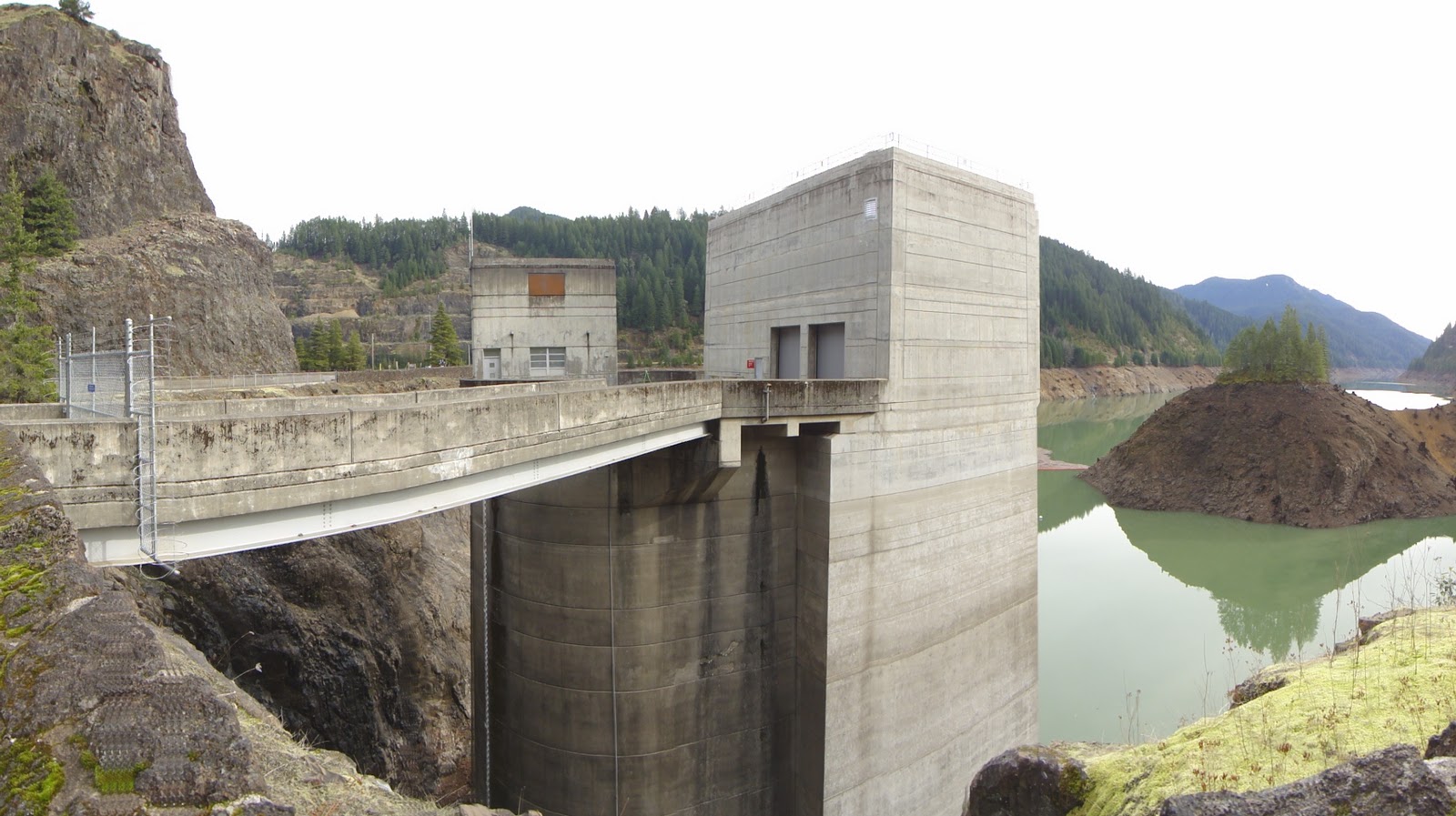
I stopped off at a couple of interesting places on the route back, including the nearby Cougar Dam.


This concrete tower, which reminded me of nothing more than a WW2 German bunker, is actually a  temperature control station built in 2005, ensuring that warm water from the top of the reservoir is vented downstream. The reason for this is explained below.


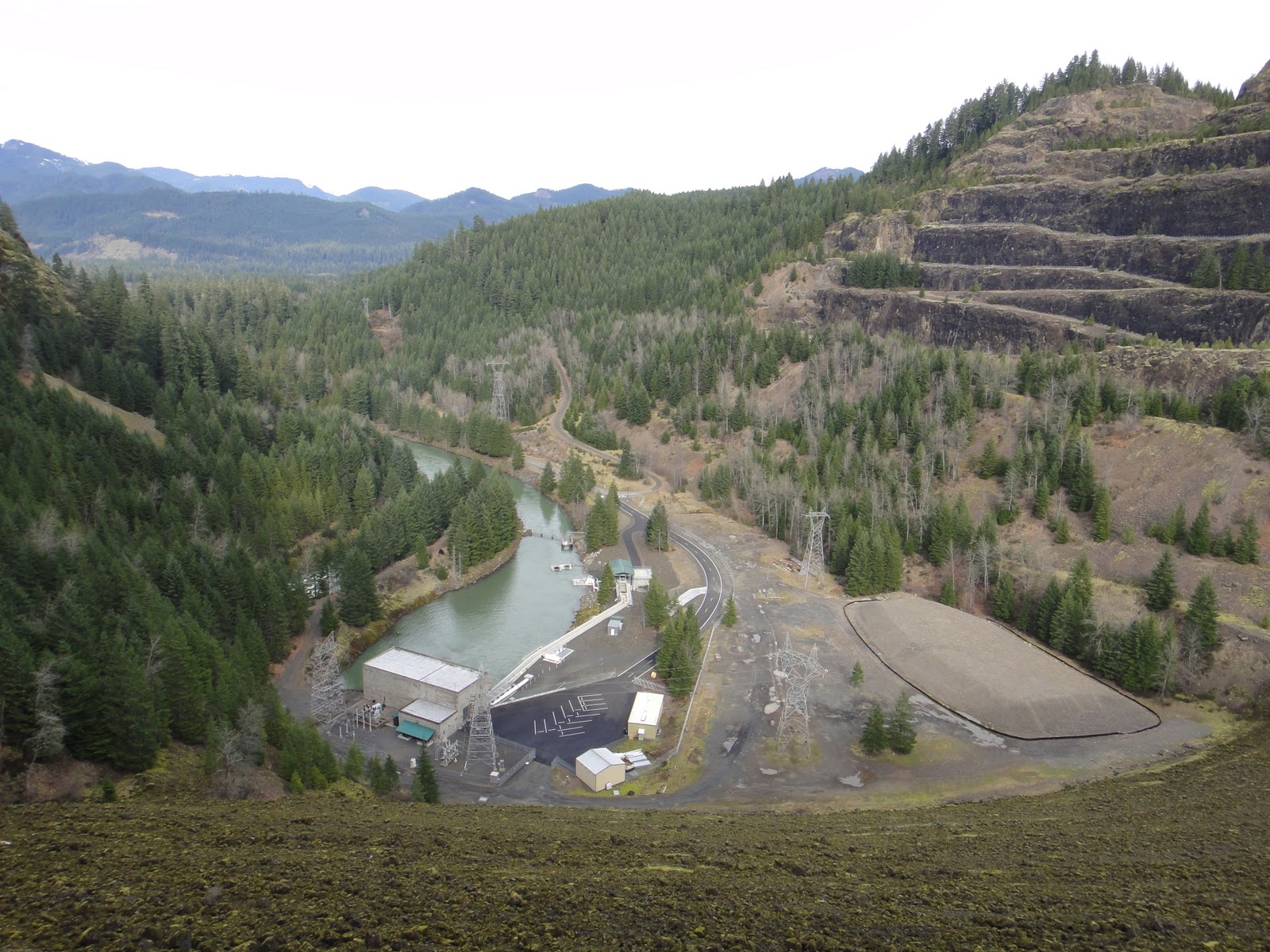
Looking over Cougar Dam towards a small hydroelectric power station, a relatively green way Oregon can generate electricity.


At a small viewpoint next to the temperature station I learnt about the measures taken to ensure that water released downstream is at the correct temperature to encourage salmon. As you can see from the logo, the dam was built and is maintained by the US Army Corps of Engineers.


The reservoir level above the dam was much lower than I expected, and the highwater mark is shown by the twigs and branches that escaped the catch net.

Thursday, 17 February 2011

Kayaking

One of the big benefits of living in Oregon is the opportunity to get into some outdoor sports. Beth is keen on skiing and rock climbing, while my wish was to get into kayaking. I had a taste of kayaking many years ago through school expeditions, and have been thinking about trying it again since we arrived.

Seeing a kayak on sale at Costco was the tipping point. I'd been eyeing kayaks at the various sports shops in town, Dick's Sporting Goods, Sports Authority and others, but the Costco one offered several advantages to the beginner. Yesterday I bought a wetsuit ($100 Bodyglove) and lifevest ($40 Stearns), and looked again at the kayaks on offer, but nothing offered better features than the Costco option, so in the evening Beth and I went and picked one up.

For those into kayaking, it is an Equinox 10.4. This offers good tracking (the ability to go in a straight line) and stability (the ability not to tip over), and the package included a decent paddle and a roof mounting system into the bargain (total $330). The kayak weights about 50 lbs, just enough for me to be able to get it on the car roof alone, but not something I'd want to hump around all day.

We had to secure it to the roof of Beth's car in the dark, but the straps and padding worked and we got home safely. Another big benefit of living in Oregon is having a two-car garage where the canoe can be stored and still fit a car alongside. Beth usually parks outside unless it's likely to frost and I have a late start, in which case I park outside and she gets the garage. Thus we unstrapped the canoe and left it in the garage alongside Beth's Mercury.

In the morning after Beth had gone to work the kayak was calling to me, so I sprang into action. Another big benefit of living in our house is that we have a creek running right past our garden. We actually own the creek for about thirty yards, until it passes our property line and becomes our neighbor's creek.

I rapidly donned my wetsuit. I only put it on backwards once (in a test yesterday) before realising that the zip goes in the back. I haven't worn a wetsuit since cave diving in the Mendip Hills, so I think my mistake was forgiveable. Cave diving, by the way, is not something I intend to repeat, as being soaking wet, freezing cold, claustrophobic (it's hard not to think of the thousands of tons of rock waiting to fall on you from above) and in imminent danger of being plunged into utter darkness if your lamp fails is not my cup of tea.

I also have special wetsuit socks, and sacrificed a $5 pair of deckshops to the water gods as my footwear for kayaking. Wetsuits should really be called sweatsuits, at least when worn indoors. They are snug as a second skin, so any thought of wearing underclothes more bulky than y-fronts can be abandoned. With a lifevest on top it gets even warmer, so I was happy to get outside into the cool February air.

Passing out of the garage, across the driveway and lawn and out onto the creek bank, it was a bit of a scramble getting the kayak down into the creek but eventually I was sitting in it, wondering how to adjust the footrests. I probably should have done this on dry land. I got one about right and couldn't even feel the other, so off I paddled anyway. Sort of. The creek is certainly deep enough at present for kayaking, but tufts of grass, fallen branches and overhanging trees and bushes all reduce the navigable width, so while I was afloat and paddling I could rarely get in more than a couple of strokes before changing direction.

Nevertheless this proved a good initial test. I hadn't forgotten how to paddle, steer and even go backwards when necessary, and I paddled up and down happily for about half an hour. My progress downstream was arrested two houses down by overgrown weeds, and two houses upstream there was a fallen tree blocking the creek, but I had about 150 yards to play with, and I justified my technical trespass by collecting lost balls, plastic bottles, and other floating debris.

Eventually I got tired and backed my kayak as close as I could to my initial embarcation point. I couldn't get ashore without putting at least one foot in the water so my deck shoes got a soaking, but that was expected. Scrambling up the bank dragging the kayak was even more fun than scrambling down, especially with a cargo of jetsam and flotsam and a couple of pints of creekwater that had dribbled off the paddles and into the bilge via my legs.

Half an hour later I had showered and dressed, emailed Beth to let her know I hadn't drowned myself, and was able to admire my haul as I fetched bottle after ball out of the kayak. One bit struck me as odd, and then it was that I discovered a problem. The footrest I couldn't feel had broken off and turned itself into debris. the footrest slid in a track, and once beyond the end of the track (and there was no stop) it had snapped off completely.

I rang Costco, and after some discussion (and three different calls) I decided to take the kayak back and exchange it. To wait for a replacement part would stop me using the kayak in the meantime. I emailed Beth to let her know, as I firmly believe that a problem shared is a problem two people have got, strapped the kayak to my car roof and set off.

At Costco a couple of staff helped me bring in the old kayak and I got a shop card refund. Then immediately I got another kayak off the stack and wheeled that one out. This time nobody helped me, but having humped various kayaks around all day I was man enough for the task and got it to the car and out of the box. Then it started to rain. Then it started to hail. I secured all the padding and straps (getting quite good at this) and got in, just as the sun came out.

Back home the sun was still shining, and I was quite tempted to go straight off to the river and have another paddle, but decided I was probably more tired than I realised and it would be better to save that for another day.

Monday, 7 February 2011

Superbowl XLV

Not every American watches the Superbowl and that's OK, but most do, and it's the biggest sporting event in the US Calendar, watched around the world, and the focus for many get-togethers.

This year thanks to WalMart refusing me the day off, I was unable to watch the game live as I have done most of the last 25 years, nor have a get-together. I have often stayed up late into the night, and on one memorable occasion ignored the pain of a broken toe for several hours before cycling to hospital and spending another several hours waiting to be given a couple of pain killer tablets and some toe strapping.

This was only my third Superbowl watched while in the USA, at least I able to get home and watch the recording before game was finished, and thus avoid all the Facebook updates telling me who won and spoiling my fun.

This year it was a close game, coming down to the last two minutes which many of Superbowls have failed to do. There is more supposed parity in the NFL (the governing body for Football in the US) than in the British Premier League, but the big game is still dominated by a handful of teams. You can share out the money equally, and try to share out the talented players equally, but you'll still get teams that draft better, coach better, and motivate better.

This year the game was won by the Green Bay Packers, the only team in the NFL owned by the fans rather than some billionaire businessman or the heir(s) of an original owner, so in a way it's a victory for the common man.

Followers